Apprenticeship: The Living Thread of Craft in the 20th Century
12/16/20252 min read
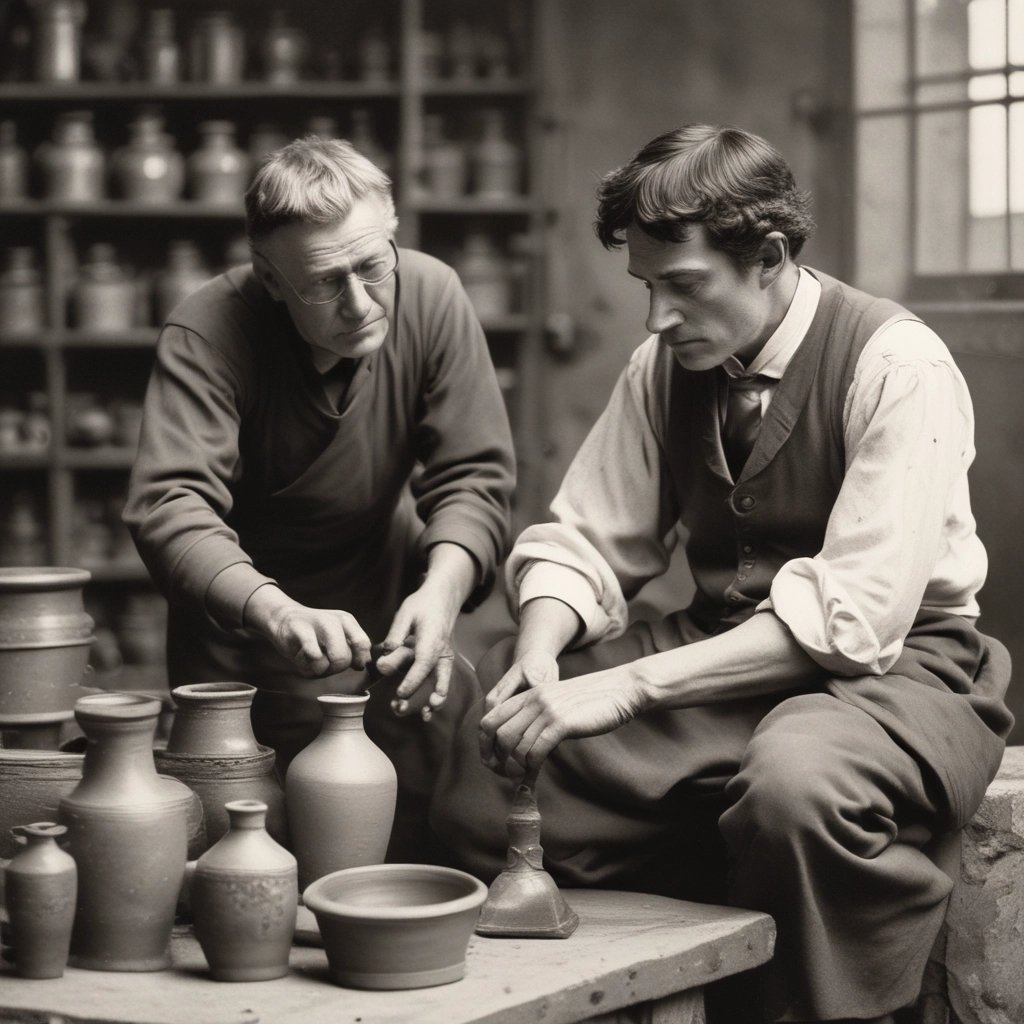
If one stepped into a workshop in the mid‑20th century, the air would be thick with the scent of clay, wood shavings, or hot metal. Tools lined the walls; their handles worn smooth by decades of use. At the center stood the master craftsperson—steady hands, practiced eyes—while a young apprentice watches every movement, eager to catch the rhythm of a tradition older than industry itself. The young person (often starting in early teens) would be bound by contract to a master craftsman for up to 7 years.
The master–apprentice method of learning wasn't about lectures or textbooks. It was about immersion. Apprentices learned by standing close enough to hear the rasp of a file, the feel of the heat of a kiln, or the quiet mutter of a master correcting a mistake.
At first, the apprentice swept floors, wedged clay, or prepared raw materials. Slowly, they were invited to shape a pot, carve a foot, and apply glaze. Each gesture was a lesson, each correction a reminder that craft is not just skill—it is discipline, patience, and respect for the material … and the method. It could be years before the master allowed the apprentice to show or sell their work.
This teaching model carried the weight of centuries. Even as factories roared and machines promised speed, the workshop remained a place where knowledge was passed hand to hand, generation to generation.
The apprentice wasn’t just learning a trade; they were being initiated into a lineage. The master’s role was not only to teach technique but to guard the integrity of the craft, ensuring that traditions—whether wood‑fired ceramics, hand‑loomed textiles, or bespoke furniture—would not vanish in the shadow of mass production.
By the mid‑20th century, the world was changing fast. Technical schools offered standardized training, and industries demanded efficiency. Apprenticeships, with their years of slow progression, seemed out of step with modern economies.
Yet in studios and small workshops, the old ways endured. American Ceramic Studio movement Masters embraced artistic expression and continued to take on apprentices, knowing that some things—like the feel of clay could never be taught in a classroom.
Today, when we look back at the master–apprentice tradition, we see more than a teaching method. We see continuity—a thread that ties us to the past. It reminds us that craft is not just about objects; it is about relationships, mentorship, and the slow unfolding of mastery.
In every handmade pot, every carved beam, every woven cloth, there is a whisper of that workshop: the master’s steady hand guiding the apprentice’s uncertain one, until the rhythm of craft becomes second nature.
The master–apprentice system was never simply about skill transfer. It was about belonging, about stepping into a story larger than oneself. In a time of technology, artificial intelligence, and mass-produced hyper consumerism, the master-apprentice system keeps alive the human heartbeat of craft.