
Part I. Before Electric Kilns: A Short History of American Pottery’s Earliest Roots
1/4/20263 min read
The American Ceramic Studio Movement.
(Note: This series of posts focuses on European‑centric ceramic developments in the United States. I fully acknowledge the significance of Native American ceramic traditions and plan to explore them in a dedicated future series.)
Part I. Before Electric Kilns: A Short History of American Pottery’s Earliest Roots
Long before paint‑your‑own‑pottery studios popped up in shopping plazas, and long before community ceramic centers welcomed hobbyists and the clay‑curious…
Long before colleges offered MFAs in ceramics or museums began collecting contemporary clay…
Long before stoneware arrived in tidy 25‑pound bags or glazes came premixed in pint jars…
Long before electric wheels hummed in the majority of studios and TikTok filled our feeds with spectacular wheel‑throwing mishaps…
Long before all of that, America was a very different place for potters.
Even before the American Industrial Revolution transformed a rural, agrarian nation into an industrialized, wage‑labor economy—and before the Arts and Crafts movement pushed back against the loss of craftsmanship and meaningful work—ceramics in America had a complicated, if not a underdeveloped, beginning.
For the first 175 years after Jamestown was established in 1607, colonists were forbidden to produce their own dinnerware or storage vessels. England already had a thriving pottery industry, and the Crown had no interest in allowing colonial competition. Pottery was something you imported, not something you made.
After the War for Independence, urban Americans continued to rely on imported ware.
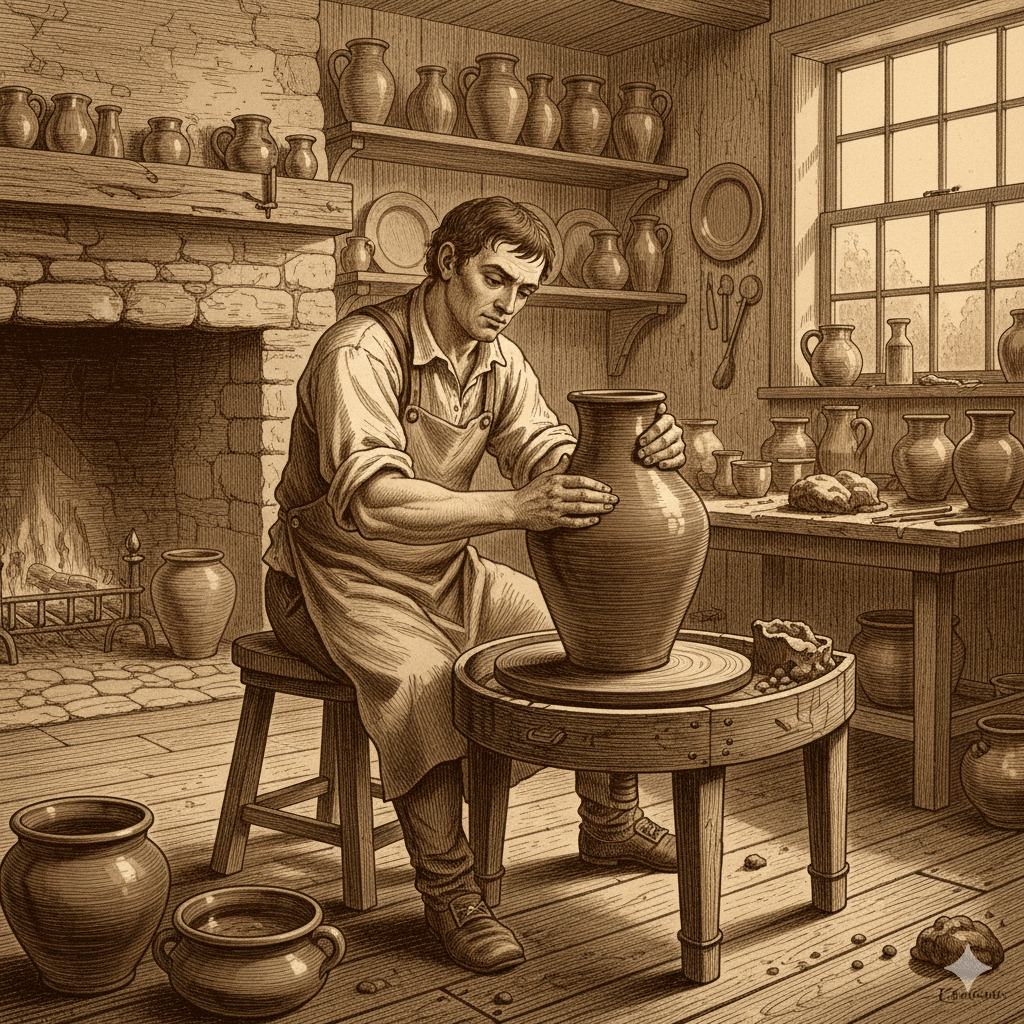
However, out in the countryside and as people moved westward from the seacoasts, local farmers dug and processed local clay and created utilitarian "redware," designed for everyday kitchen and dairy use. During this time new arrivals from Europe brought skills and techniques required to make more sophisticated ware. Slowly the American “handcraft” industry began to take shape.
The ceramic industry took more than a century to fully form. The small agrarian makers slowly gave way to larger concerns organized around deposits of clay. For instance, East Liverpool, Ohio had a specific deposit of yellow clay that was easily accessible along the banks of the Ohio River. The region welcomed immigrants from Scotland, England, and Germany to work in over 100 potteries making more than half of the dinnerware used in the America by the mid-1800s.
The next major turning point for the ceramic industry came with the Industrial Revolution. Until then, pottery remained a small‑scale, loosely organized craft. Industrialization transformed it entirely, shifting ceramics from a predominantly handmade tradition to a modern, mechanized industry.
As the need for skilled handcraft workers increased, new professional organizations emerged to support the field. In 1898, teachers, industrialists, engineers, chemists, geologists, and artists came together to form the American Ceramic Society, creating a forum for sharing scientific knowledge and advancing ceramic research. Just a few years earlier, in 1894, The Ohio State University had established the nation’s first Ceramic Engineering department, signaling the growing academic and industrial commitment to the discipline.
In response to what many saw as a decline in craftsmanship brought on by industrial mass production—and driven by a desire to elevate handwork to the status of fine art—the Society for Arts and Crafts was founded in Boston in 1897 to promote higher artistic standards in the handcrafts. Its mission quickly became a cornerstone of the American Arts and Crafts movement. Within this movement, pottery emerged as a vivid expression of the belief that beauty and integrity arise from the maker’s direct engagement with material.
Small workshops and studios took the place of factories, and the potter’s wheel became an emblem of the movement’s commitment to individual craftsmanship over mechanical uniformity. In this spirit, pottery was understood not simply as functional ware but as a moral and aesthetic position: a return to human scale, to the dignity of skilled labor, and to the conviction that everyday objects could embody both usefulness and quiet artistic truth.
Across the diverse landscape of Arts and Crafts practitioners, three primary groups took part in handcraft work: guild‑trained artisans employed by small pottery firms; medical professionals who used craft therapeutically to treat nervous disorders; and dedicated hobbyists who built their own tools, dug their own clay, and constructed wood‑fired kilns for personal exploration.
My future blog entry in this series will explore the further development of the American Craft Movement the giants who pushed clay from being utilitarian ware and into museums.